
MARKETS
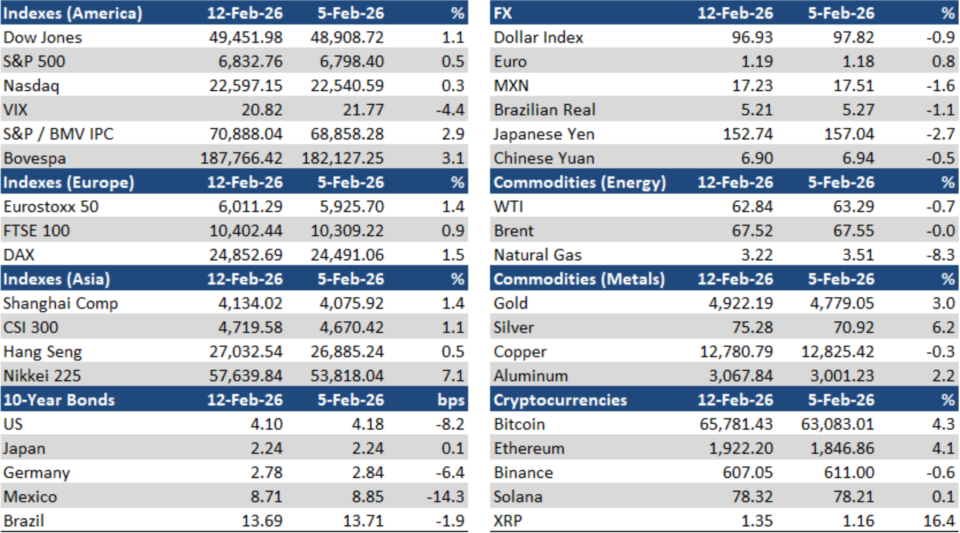
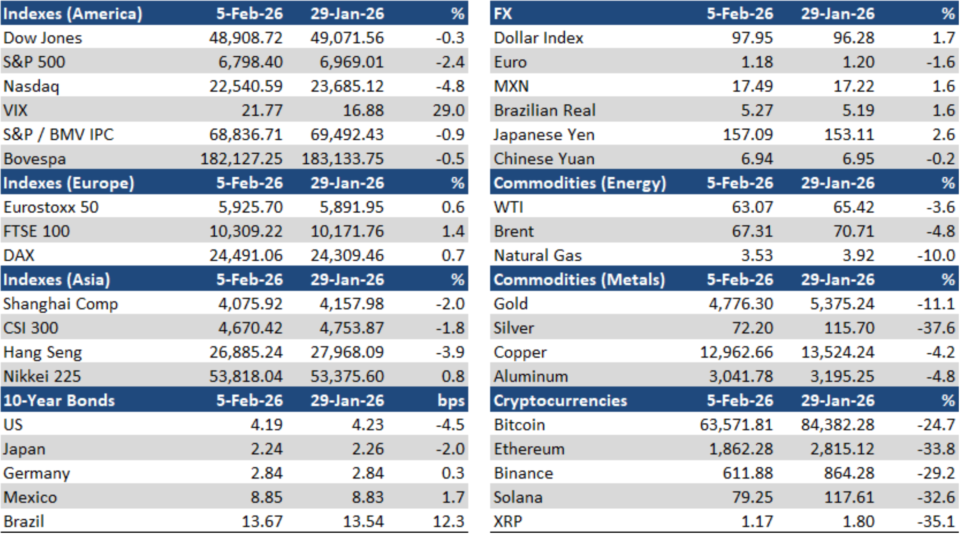
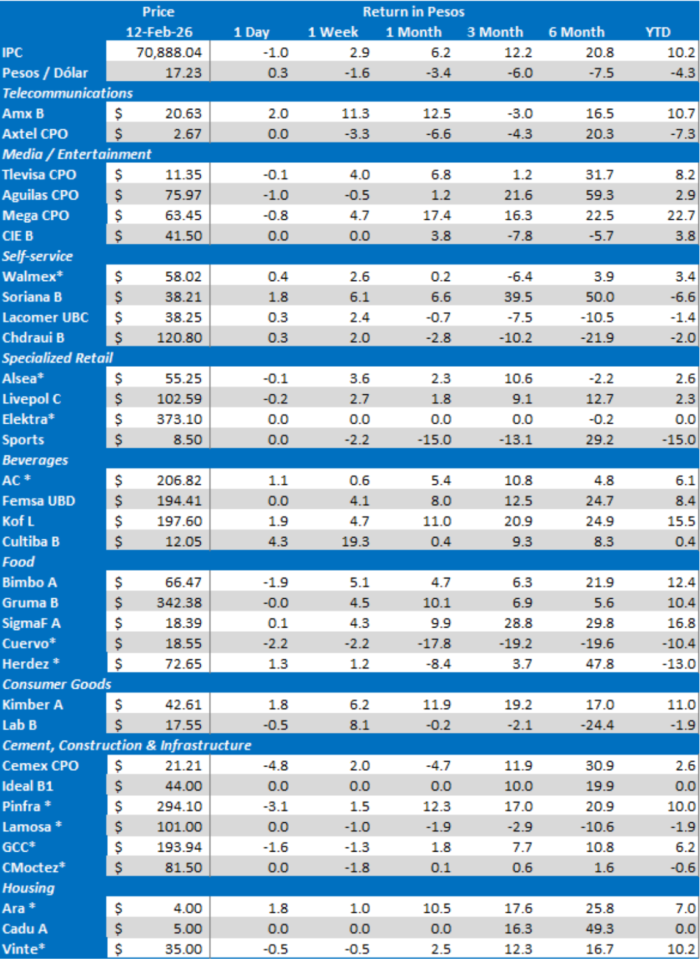
The S&P / BMV IPC rallied 2.9% to close at 70,888.04 pts, after reaching a new intraday historically high on Thursday, due to AMX’s solid report, some positive macro data and global risk-on tone. Meanwhile, the Mexican peso appreciated 1.6% to close at MXN$17.23/USD; the yield of the 10-year M-Bono was down 14 bps to 8.71%.
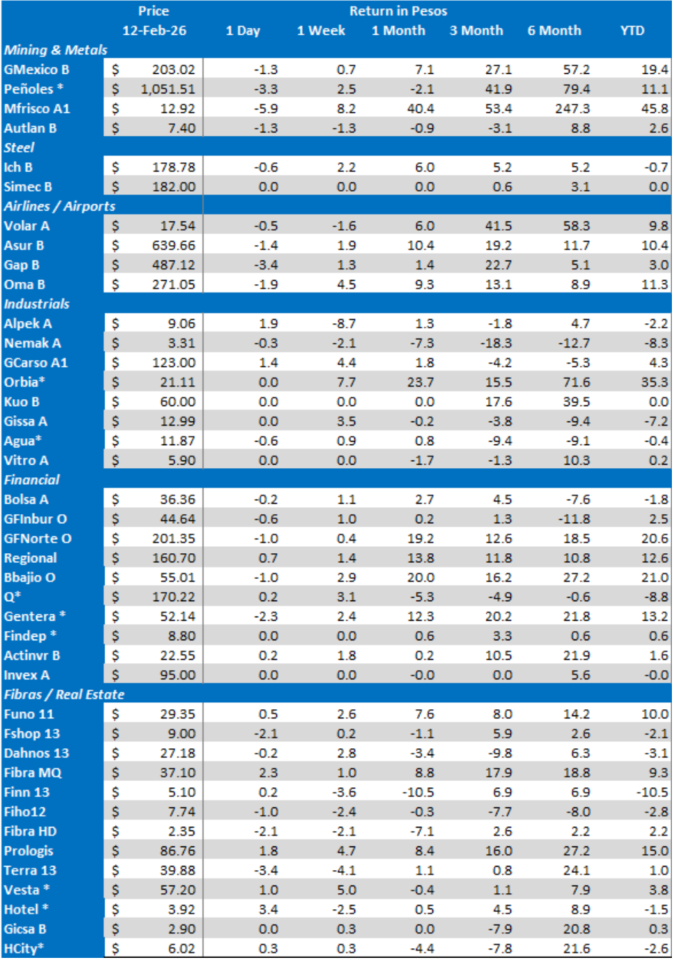
The S&P / BMV IPC’s top gainers were: AMX B (+11.3%), LAB B (+8.1%), and ORBIA * (+7.7%). On the other hand, the main losers were: CUERVO * (-2.2%) and GCC * (-1.3%).
LISTED COMPANIES
AMX posted positive 4Q25 results, rallying 11.3% over the week. Revenues were up 3.4% YoY, supported by mobile service momentum, broadband expansion and equipment sales strength. Service revenues increased 2.3% YoY, reflecting mobile service revenue growth of 6.2% at constant FX from postpaid traction and resilient prepaid demand. Post-paid net additions reached 2.8 million, led by Brazil, Colombia and Mexico, while pre-paid net additions contributed 647 thousand, mainly from Mexico, Argentina and Colombia, and broadband net additions totaled 524 thousand, driven by Mexico and Brazil fiber rollout. EBITDA grew 4.2% YoY backed by cost controls and operating leverage, with EBITDA margin at 38.8%, up 30 bps YoY. Net profit jumped more than 300% YoY, as comprehensive financing costs dropped roughly 48% YoY. Net debt to LTM EBITDAaL closed at 1.52x, after free cash flow rose 39.4% YoY and cash generation reduced net debt. The company expects a Capex of 14-15%of revenues. AMX lost the bid for Telefónica’s Chilean assets against Millicom/NJJ Holding. However, the Mexican telecom company is looking to reduce leverage to undertake acquisitions in Latin America.
Orbia is close to selling its Netafim unit to Chinese billionaire Howie Wang, who owns a majority stake in the private irrigation company Dayu Irrigation, the Israeli portal Calcalist reported. Orbia would receive US$1.12 billion for its 80% stake, which is equivalent to 50% of its current market capitalization.
GCarso reported weak 4Q25 results. Total revenues were down 4.7% YoY, pressured by peso appreciation and the completion of large infrastructure projects. Retail revenues rose 2.3% supported by stronger seasonal demand at Sanborns; industrial revenues declined 5.5% reflecting weaker auto-parts demand and FX effects; infrastructure and construction revenues fell 35.9% due to project completions and early stages of new works; Elementia revenues slipped 2.8% impacted by FX and a one-time plant shutdown; Carso Energy revenues decreased 11.8% on FX and lower Panama energy sales despite resilient gas transportation; Zamajal revenues surged 465.2% following the Ixachi drilling agreement with Pemex. EBITDA dropped 31.7% YoY as infrastructure losses, Elementia’s one-off charge, technology investments in retail, and FX headwinds offset cost controls, driving EBITDA margin down to 11.4%, from 15.9%. Net profits declined 18.9% amid lower operating income and adverse FX. Grupo Carso confirmed it was awarded a mixed contract from Pemex for the exploration of the onshore Macavil field, with proven reserves of 33.7 million barrels of condensate and 409.1 billion cubic feet of natural gas.
Walmex’s Board of Directors appointed Kyle Kinnard as a Board Member, replacing Karthik Raghupathy, who notified the company of his decision to retire from the Board, effective February 12th. Kyle Kinnard is Executive Vice President and COO of Walmart International. In this role, Kyle leads the teams responsible for overseeing Walmart’s markets in Mexico, Central America, Canada, Chile, and South Africa. Kyle began his career with Walmart in 2000 as an hourly associate at Sam’s Club 8209 in Springdale, Arkansas. Over the years, he held various leadership positions at Sam’s Club U.S., from club manager to Vice President and Divisional Director of Merchandise. He also held management positions at Sam’s Club China and Sam’s Club Mexico before returning to the US as Senior Vice President of Home.
Arca Continental reported soft 4Q25 results. Consolidated revenues were down 0.6% YoY, reflecting softer consumption trends and lower volumes across regions, while total volumes declined 0.8% YoY due to contractions in Mexico and South America partially offset by growth in the US. Gross profit fell 1.7% YoY with gross margin compressing 60 bp to 47.6% amid higher input costs and unfavorable mix. EBITDA decreased 4.5% YoY (below Bloomberg consensus) with EBITDA margin contracting 80 bp to 21.0%, driven by margin pressure in the US and South America despite disciplined cost control. Net profits declined 11.5% YoY as lower operating income and higher financing costs outweighed tax efficiencies. The 2026 guidance calls for mid-single-digit consolidated sales growth supported by price increases at least in line with inflation and CAPEX of around 7% of sales.
Sigma Foods reported solid 4Q25 results with record revenues and EBITDA. Total revenues advanced 12% YoY driven by selective price actions, modest volume growth, and a favorable FX translation, particularly in Mexico and Europe. Comparable EBITDA increased 34% YoY supported by strong operating execution across regions and insurance reimbursements in Europe, while the EBITDA margin expanded to 11.6%, from 10.3%, reflecting operating leverage and pricing discipline. Net profit turned positive due to higher operating income and FX gains versus losses in 4Q2. For 2026, management guided to volume growth of around 2%, revenue growth of 4–7% depending on FX, comparable EBITDA growth of 5–10%, and a 27% Capex increase focused on capacity expansion in the Americas and recovery in Europe.
Alpek registered weak 4Q25 results. Total revenues declined 12% YoY, reflecting a weaker pricing environment, lower volumes, softer demand, extended maintenance shutdowns and reduced export activity across Polyester and Plastics & Chemicals. Comparable EBITDA showed a 40% YoY contraction due to pressured reference margins, historically low ocean freight rates and unfavorable price spreads, mainly in Polyester, partially offset by more resilient margins in EPS and stable performance in Plastics & Chemicals. EBITDA margin compressed 310 bps to 6.6% as margin pressure, lower scale absorption and adverse mix outweighed cost and footprint optimization efforts. The net loss widened to US$86 million as weaker operating results, inventory adjustments and financial costs surpassed operating gains. For 2026, Alpek projects EBITDA between US$450-500 million, with potential upside near US$50 million of EBITDA from higher PET margins, stronger freight rates, FX depreciation, tariff capture and non-strategic asset sales, volume near 4.5 million tons, operating free cash flow of US$100-150 million, with CAPEX of US$130 million. Alpek filed a warning notice with the state of Pennsylvania in January 2026, announcing its plans to close its Reading plant on March 15, affecting approximately 100 workers, according to public information.
KUO reported weak 4Q25 results. Consolidated revenues declining 5.3% YoY due to lower domestic volumes in Pork Meat, softer North American demand in Transmissions and Polymers, pricing pressure in Synthetic Rubber from Asian competition, and a stronger peso, partially offset by a better product mix and pricing at Herdez del Fuerte. EBITDA decreased 2.9% YoY due to tariffs, unfavorable FX, higher distribution costs in Transmissions, and tax-credit-related expenses in Pork Meat, which were partially offset by lower feed costs, operational efficiencies in Pork Meat, margin improvement in Polymers from lower export costs and inventory effects, and stable performance at Herdez del Fuerte. EBITDA margin expanded 20 bps YoY to 9.3% as cost efficiencies offset revenue pressure. Net loss narrowed 63.4% YoY, reflecting lower cost of sales and a sharp reduction in net financial expenses driven by FX gains and lower interest costs.
Bolsa reported soft 4Q25 results. Consolidated revenues were flat YoY, supported by stronger cash equities and derivatives trading activity, higher medium- and long-term debt listings, and solid Information Services growth, which offset weaker derivatives clearing and OTC performance. EBITDA fell 9% YoY due to a 15% rise in operating expenses linked to strategic projects, technology upgrades, digitalization, higher personnel costs, and greater depreciation and consulting fees. EBITDA margin compressed by 529 bps to 54%. Net profit dropped 20% YoY, affected by lower operating income, reduced net financial results from interest rate cuts and FX effects, and a higher effective tax rate. The company expects a MXN$500 million Capex and its operating expenses to rise at a high single digit. Bolsa will propose the payment of a MXN$2.05/share dividend and to keep the amount of the share buy-back reserve at its April 30th shareholders’ meeting.
Fibra Nova reported positive 4Q25 results. Total revenues increased 14.8% YoY mainly as a result of portfolio expansion, the signing of new leases on several properties, primarily with ATI Ladish, Brake Parts, Regal Rexnord, and Veritiv, and rent adjustments in dollars. The NOI margin decreased to 97.0%, from 97.5%, due to higher operating expenses, but NOI rose 14.2%. EBITDA grew 27.6% due to an extraordinary gain related to the recovery of tenant-related expenses, which boosted the margin by 10 PP to 100.2%. FFO was 20.0% higher, with a 94.6% margin. Fibra Nova plans to distribute MXN$364.2 million (MXN$0.6134/CBFI), with an 18.7% increase, corresponding to 4Q25 results.
Cemex will propose the payment of a previously announced US$180 million dividend with a 40% increase and the creation of a US$500 million share buy-back reserve, at its March 26th ordinary shareholder’s meeting. In related news, Cemex Ventures announced an investment in Waste to Energy Advanced Solutions (WtEnergy), a startup focused on converting non-recyclable solid waste and biomass into clean energy, reinforcing Cemex’s strategy to scale circular-economy and decarbonization solutions through open innovation.
Invex Controladora finalized the sale of its remaining 20% ownership in the Gana highway project after receiving all required regulatory approvals and third-party consents. The transaction amounted to around MXN$3.96 billion which were paid in kind through FMX23 CBFEs. As a result, Invex Controladora increased its ownership in FMX23 from 17.7% to 27.7%. The sale was executed alongside FMX 23’s MXN$10.3 billion follow-on. Invex expects the transaction to contribute roughly MXN$1.2 billion to its 1Q26 net income. Gana operates key toll road segments — Amozoc–Perote and the Perote bypass — which are part of the corridor linking Mexico City with the Port of Veracruz.
The National Antitrust Commission ordered Ferromex, a subsidiary of Grupo México Transportes, to divest the Nogales-Guaymas section of its Pacífico Norte concession, after identifying competitive barriers in rail freight transport. The measure is part of a preliminary ruling published in the Official Gazette of the Federation.
Asur’s total passenger traffic increased 3.6% YoY to 6.7 million in January. Colombia’s traffic rose 15.0% and Mexico’s 0.9%, while Puerto Rico’s declined 2.1%.
Volaris’ total passenger traffic was up 4.7% YoY to 2.72 million in January, with domestic traffic increasing 3.6% and international traffic rising 7.5%. ASM’s were 4.3% higher, but RPM’s only advanced 2.1% as the load factor decreased 1.8 PP to 84.8%.
KOF issued MXN$10 billion in domestic bonds (“Cebures”). The transaction was structured in tw tranches with ticker symbols KOF26 and KOF26-2. The first tranche consisted of a MXN$7 billion bond with a fixed interest rate of 9.12% (Mbono +0.43%) and a 10-year term. The second tranche amounted to MXN$3 billion with a variable interest rate of TIIE + 0.38% and a 3-year term. The transaction was rated ‘mxAAA’ from S&P Global Ratings, and ‘AAA.mx’ from Moody’s Local MX. KOF intends to use proceeds for general corporate purposes, including the refinancing of maturing debt.
Grupo Elektra’s Banco Azteca has launched its first mutual fund AZTECA 1, which is available through the bank’s mobile app. It will be managed by Operadora Actinver. Banco Azteca expects to reach MXN$5.0 billion in AUM’s in the first year of operations.
Carlos Slim’s investment firm Control Empresarial de Capitales sold approximately 1.7 million shares of PBF Energy across 13 transactions so far in 2026, reducing its stake from 26.6% to 25.4%, according to SEC filings.
Nemak announced it has closed the acquisition of GF Casting Solutions’ automotive business, after meeting all required regulatory approvals and closing conditions.
Fibra Storage purchased a “Guardabox” branch in the state of Querétaro for MXN$22 million, reaching 36 units in operation. Fibra Storage also bought a plot of land in the city of Tijuana, Baja California for MXN$33 million.
OTHER COMPANIES
The CFE issued two bonds amounting to US$1.5 billion last January 28th in two tranches: i) an 8-year bullet bond with a 6.045% coupon rate, proceeds of which were used entirely to refinance other external market debt; ii) an amortizable bond with a 25-year term (average life of 12 years) and with a 6.5% coupon rate, with resources being allocated to investment projects throughout 2026.
Nu Mexico plans to have ‘’invested’’ (capex and opex) US$4.2 billion 2020-2030 in short- and long-term strategic spending as part of its expansion strategy.
Grupo Coppel plans to invest MXN$14.0 billion in 2026 to expand commercial infrastructure, strengthen technology capabilities, and accelerate clean-energy adoption as part of its 2026–2030 transformation plan totaling MXN$80.0 billion. Of the 2026 allocation, 43% will be aimed at store and logistics infrastructure, 31% to technological transformation for omnichannel integration, and 26% to energy transition, including the remodeling of more than 100 locations, the opening of 2,000 stores, and the creation of approximately 2,500 direct jobs.
AT&T México registered 3.96 million lines in the National Mobile Users Registry, equivalent to roughly 16% of its 24.7 million customer base.
Grupo Vivaerobus’s total passenger traffic increased 3.7% YoY to 2.45 million in January 2026. RPM’s declined 0.1% as ASM’s increased 1.9% but the load factor fell 1.9 PP to 83.5%.
Cryptocurrency exchange Bitso, has added Tether Gold (XAU), a digital asset backed by physical gold, to its crypto listings. Each XAU token represents one troy ounce of fine gold, backed by physical gold bars that meet the LBMA Good Delivery standard and are stored in secure vaults in Switzerland.
SilverBlue, a company specializing in investment, capital structuring, and sustainable finance, plans to invest MXN$500 million in a renewable energy portfolio in Mexico, according to local newswires. The company acquired Solage, a finance company specializing in distributed energy and storage projects.
Auntie Anne’s plans to open 40 stores in Mexico over the next six years, in partnership with Beegroup, in formats ranging from shopping malls to airports, hospitals, and stadiums. The first store opened on January 19 in Monterrey, Nuevo León.
Daypass.com, a Mexican traveltech, closed a €2.0 million financing round. The company plans to expand its operation to 26 countries.
ECONOMIC
Headline inflation rose 0.38% in January 2026, below the Citi Mexico Expectations Survey consensus projection of 0.42% for the month. Core inflation increased 0.60% (vs. a 0.58% consensus forecast), driven mainly by higher food, beverages and tobacco prices, while the non-core inflation rate fell 0.36%, reflecting declines in agricultural and other volatile food items that offset a small rise in government-authorized tariffs. On an annual basis, headline inflation stood at 3.79% and core inflation at 4.52%, according to the INEGI release.
The Consumer Confidence Index declined 0.9 pts to 44.0 in January 2026, the lowest level in the last 37 months, with a broad contraction in all components, in particular the current (-0.9 pts) and expected (-0.7 pts) household economic condition, according to INEGI. The CCI decreased 2.7 points YoY due to sharp declines in the current (-4.6 pts) and expected (-6.5 pts) situation of the country.
Formal employment in Mexico declined by 8,104 positions in January 2026, marking the first January job loss since 2009, according to IMSS. Total registered employment stood at 22.51 million positions, equivalent to 0.9% YoY growth, partly reflecting adjustments in platform-based employment.
Industrial production increased by 0.2% MoM (seasonally adjusted) in December, slowing down marginally against the previous two months, according to INEGI. The main drivers were construction (+1.2%), utilities (+0.7%) and mining (+0.5%), while manufacturing declined 0.1%. Industrial production advanced 2.4% (original data), reversing the annual reductions of the last eight months, supported mainly by construction (+6.6%), utilities (+3.9%), manufacturing (+1.3%) and mining (+0.6%).
Light vehicle sales increased 8.7% YoY to 131,491 units in January, INEGI reported. Production fell 2.7% YoY to 303,980 units while exports grew 2.3% to 224,528 units.
Heavy vehicle sales declined 46.3% YoY, while production fell 51.9% and exports were down 53.8% YoY in January, according to INEGI.
Fiscal revenues increased 11% YoY in real terms in January to MXN$595.8 billion, exceeding the budgeted figure. VAT revenues were up 1.4%, income taxes +13.5%, and IEPS +18.8%.
Banco de México will consider additional adjustments to the benchmark interest rate as macroeconomic conditions allow, according to Governor Victoria Rodríguez Ceja in an interview with El Financiero newspaper. On the other hand, hawkish deputy governor Jonathan Heath said that Banco de Mexico’s governing board should act with greater caution in the current monetary easing cycle until it assesses that core inflation shows a clear downward trend.
The Senate unanimously approved President Claudia Sheinbaum’s labor reform which will gradually reduce weekly working hours from 48 to 40. The initiative was turned over to the Chamber of Deputies, where it will be voted next week.
The Ministry of Economy has a portfolio of 20-30 energy projects amounting to US$200 billion, according to Diana León, head of the Energy sector. These projects are part of the US$407 billion investment portfolio, which was announced last week by Secretary Marcelo Ebrard.
President Claudia Sheinbaum stated that, at her administration’s request, private companies will voluntarily return more than 200 unused mining concessions to the Mexican state, aiming to rationalize resource allocation without compulsory measures.
CETES auction: 28-day CETES -2 bps to 6.88%; 91-day CETES -3 bps to 7.00%; 175-day CETES -5 bps to 7.10% and 679-day CETES -24 bps to 7.58%.
Download PDF: Mexican Market Chatter February 5th – February 12th