
MERCADOS
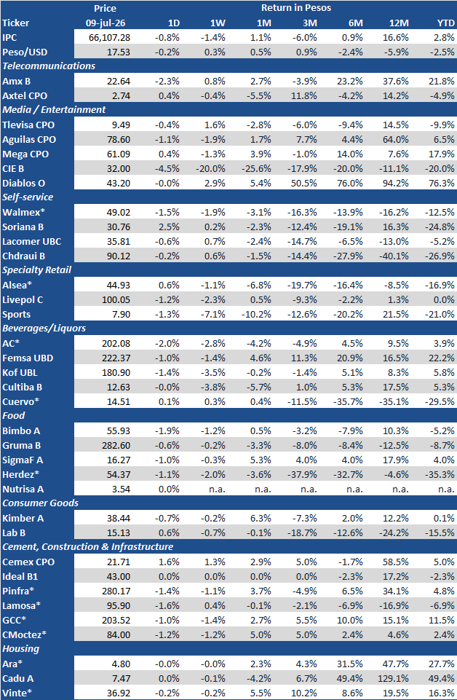
En S&P / BMV IPC fell 1.4% over the week to close at 66,107.28 pts., due to continued USMCA uncertainty. Meanwhile, the Mexican peso lost 0.3%, closing at MXN$17.53/USD, while the yield of the 10-year M-Bono was 59 bps to 9.60%.
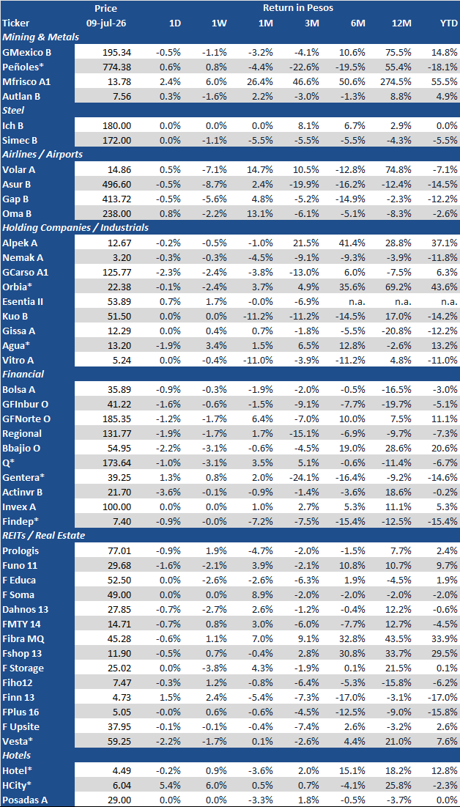
En S&P / BMV IPC's top weekly gainers were: TLEVISA CPO (+1.6%), CEMEX CPO (+1.3%), and PEÑOLES * (+0.8%). On the other hand, the main weekly losers were: ASUR B (-8.7%), VOLAR A (-7.1%) and GAP B (-5.6%).

CORPORATE NEWS
Grupo Aeroméxico’s total passenger traffic declined 9.0% to 1.85 million in June, its weakest performance since the pandemic, driven mainly by a 13.0% reduction in domestic traffic and a 1.4% fall in international traffic. RPM’s were down 2.8% as ASM’s increased 0.9% but the load factor decreased 3.0 PP to 82.7%.
Grupo Aeroportuario de Sureste’s total passenger traffic was down 5.8% YoY to 5.6 million in June. Mexico’s traffic declined 8.5%, Puerto Rico’s 4.6% and Colombia’s 1.1%.
Grupo Aeroportuario del Centro-Norte’s total passenger traffic increased by 2.1% YoY to 2.4 million in June. Domestic traffic advanced 0.8% while international traffic was up 10.2%.
Grupo Aeroportuario del Pacífico’s total passenger traffic decreased 5.1% YoY to 4.9 million in June. Domestic traffic fell 1.9% while international traffic was down 9.1%.
Volaris’ total passenger traffic increased by 11.2% YoY to 2.68 million in June, with domestic traffic up 8.8% and international traffic growing 18.6%. RPMs rose 8.4% as ASM’s were 8.7% higher but the load factor declined 0.9 PP to 83.6%.
Fibra Mty has successfully completed the sale of two office properties located in Nuevo Leon and Jalisco for MXN$395 million and US$31.3 million, respectively, as was previously announced. Proceeds from the sale may be used for investments in industrial properties and/or for the implementation of the CBFI repurchase program.
Fibra Uno plans to issue MXN$3.5 billion in 3- and 10-year bonds under its MXN$60 billion debt program to refinance its FUNO 23-2L and FUNO 23-3L notes. The offering includes a floating-rate three-year bond and a fixed-rate 10-year bond, with final spreads to be determined at pricing. The company may upsize the transaction by MXN$4.0 billion, bringing the total issuance to MXN$7.5 billion. Both bonds received AAA(mex) ratings from Fitch Ratings and HR Ratings.
Bolsa reported that the amount issued of medium and long-term debt increased by 71% YoY to MXN$18.74 billion while the amount of short-term debt declined by 11% YoY to MXN$24.9 billion in June. Equities ADTV was down 6%, which included a 4% reduction in the domestic market and an 8% decrease in the global equity market.
Actinver and Alterna Asesoría Internacional acquired a combined 8% equity stake in Spain’s Singular Bank as part of a consortium led by ING that purchased 84.5% of the private bank from Warburg Pincus. ING will hold 40%, ProA Capital 15%, and a group of family offices 21.5%, while Singular Bank’s management team raised its combined stake to 15.5%. Closing is expected in the first quarter of 2027, pending regulatory approval.
TV Azteca was formally admitted into court-supervised insolvency proceedings (“Concurso Mercantil”). The company has now entered a 158-day conciliation period to negotiate a financial restructuring, primarily with holders of its US$400 million bond due in 2024. TV Azteca has proposed a haircut of up to 90% on the bond debt and says the process will preserve continuity of its operations and broadcasts.
S&P Global Ratings raised Grupo Vinte’s national-scale rating to ‘mxAA-’ from ‘mxA+’, under S&P National Ratings, and its global-scale long-term issuer credit rating to ‘BB’ from ‘BB-’, under S&P Global Ratings, with a Stable outlook. The agency said Grupo Vinte has strengthened its competitive position through the successful integration of Javer, while adjusted leverage fell to 2.8x as of end-March 2026. S&P expects the homebuilder to sustain solid operating and financial performance over the next 18 months, supported by favorable sector fundamentals and disciplined capital allocation, and projects adjusted debt/EBITDA will remain below 3.0x with solid liquidity over the next 12 months. The Stable outlook reflects S&P’s expectation that Grupo Vinte will maintain a flexible business model capable of adapting its product offering to Mexico’s evolving housing market.
OTRAS EMPRESAS
President Claudia Sheinbaum said the recently signed memorandum of understanding between Pemex and Petrobras is primarily aimed at supporting the redevelopment of the Cantarell oil field. Petrobras will contribute its deepwater exploration and production expertise, while both companies will also cooperate on upstream projects, industrial processes, and the exchange of regulatory and institutional best practices. In related news, President Sheinbaum said that Pemex aims to reach production of 1.8 million barrels per day, with the entire volume earmarked for domestic refineries. She added that the Dos Bocas refinery is now fully operational and increasing output following repairs tied to a fatal accident in March. Sheinbaum said the fuel-import period recorded earlier this year was linked to those repair works.
Nubank will invest around US$4.2 billion in Mexico over the 2026-2030 period. The announcement followed a meeting between Nubank founder and chief executive David Vélez and President Claudia Sheinbaum at the Palacio Nacional.
Toyota Motor Corp will build a new US$3.6 billion assembly plant in San Antonio, Texas. The 2.5 million-square-foot facility will open in 2030 and create 2,000 jobs, according to the company. Toyota said it will transfer mid-size Tacoma production from its Toyota Manufacturing in Tijuana, Baja California, to the new Texas site once construction concludes. The company confirmed it will continue building Tacoma trucks at its existing plant in Guanajuato, reiterating its commitment to Mexican operations. The Economy Ministry said that another international car manufacturer will announce a US$500 million investment in Mexico over the next few days.
Equifax announced the acquisition of credit bureau Círculo de Crédito for US$750 million. Círculo de Crédito reported revenue of US$134 million for the 12 months ended June 30, 2026, a 31% increase, alongside adjusted EBITDA of US$62 million. The company serves more than 1,700 clients across banking, fintech, retail and telecommunications, and maintains roughly 2 billion tradelines covering 80 million validated identities. Equifax said more than 40% of Círculo de Crédito’s revenue comes from fintech clients, a segment that grew over 50% in 2025. The deal is subject to customary closing conditions and regulatory approvals, with completion expected in 4Q26.
Polaris Renewable Energy executed a Mixed Investment Agreement with CFE on July 3rd for three solar-plus-storage projects — Los Girasoles, Solar Energía Tres Hermanos, and Don Humberto, located in Quintana Roo, Tlaxcala, and Sinaloa — with combined capacity of 250 MW of solar generation and 61.6 MW of battery storage. The deal, valued at more than US$217 million, is structured for a 30-year term under CFE’s Mixed Development Program, the largest renewable-energy and storage procurement initiative undertaken in Mexico. Polaris still must finalize power purchase agreements and other contracts before reaching financial close, with commercial operations targeted for 2028.
The Federal Civil Aviation Agency (AFAC) revoked Magnicharters’ Air Operator Certificate on June 29th after the airline failed to implement corrective actions required following a January 2026 inspection. The regulator identified non-compliance with aviation regulations, including financial deficiencies. AFAC said the decision prioritizes passenger safety and the integrity of Mexico’s aviation system.
French energy major TotalEnergies shipped its first LNG cargo to Asia from Energía Costa Azul (ECA), a Baja California terminal operated by Sempra Infraestructura that required an estimated US$3 billion in investment. TotalEnergies, which holds a 16.6% stake, is acting as sole offtaker during the ramp-up phase under a 20-year deal for 1.7 million tonnes annually, with full commercial operations expected later this summer. ECA is Mexico’s first liquefaction and export megaproject on the Pacific Basin, with a first-phase capacity of 3.25 million tons of LNG annually.
Banco Sabadell Mexico, the Mexican subsidiary of Spain’s Banco Sabadell, is planning to raise approximately MXN$4 billion in fresh capital. Proceeds would support continued loan-book expansion at the unit, which has been scaling corporate and SME lending since its Mexican launch.
Mexican fintech Aviva raised US$18 million in a Series A round led by Valor Capital Group, with participation from BID Labs, Caravela Capital, Endeavor Forward, and existing investors Wollef, Ignia, Krealo, and Newtopia. The company said proceeds will fund expansion to 1,000 locations across Mexico, broaden its financial-product portfolio, and significantly grow its technology team.
Santander’s Openbank México, partnered with Cinépolis and Mastercard to launch the Cinépolis by Openbank credit card next July 30th, in its first co-branded card since launching in Mexico roughly 18 months ago. The no annual fee card offers up to 16% in Club Cinépolis points on in-theater purchases depending on loyalty tier, a weekly 2×1 on movie tickets, and 2% and 1% point accumulation on online and in-store purchases, respectively. Openbank said the tie-up with a loyalty base of 7.5 million active monthly Cinépolis customers is its largest strategic step since reaching one million clients in Mexico, while Cinépolis said digital transactions across its complexes have risen from roughly 20% a year ago to 40-45% currently, with a 60% target.
Safran Aircraft Engines announced plans to expand its investments in Mexico following a meeting between CEO Olivier Andriès and President Claudia Sheinbaum. The company has invested more than US$147 million in Querétaro and Chihuahua, creating 2,300 jobs. Separately, Embraer acquired the remaining 50% stake in EZ Air Interior, its former joint venture with Safran Cabin in Chihuahua, including its manufacturing facility. The transaction closed after receiving the required regulatory approvals.
Infosel and AdSoft, two Mexican financial-technology providers, announced an integration aimed at building a leading technology ecosystem for investment advisors in Mexico. The combined platform is intended to unify market-data, portfolio-management, and compliance tooling for independent advisory firms.
Nexu, a Mexican automotive financing fintech, secured a MXN$2.5 billion credit facility from HSBC México. The funding will support financing for more than 10,000 passenger vehicles, increasing the company’s cumulative auto loan originations by 50% from over 20,000 since its founding.
Following its acquisition of Mexican fintech Minu, Chilean benefits platform Betterfly said it will seek to triple its presence in Mexico over the next two to three years, targeting growth from 4,000 to roughly 15,000 client companies and from one million to around four million covered employees.
Palantir Technologies announced an enterprise expansion agreement with GNP Seguros, marking Palantir’s first publicly announced commercial customer in Latin America. GNP Seguros will scale its use of Palantir’s Foundry and Artificial Intelligence Platform across its health, life, auto, and property insurance lines to unify claims, underwriting, operations, and risk data, aiming to detect claims fraud, sharpen underwriting, and speed risk monitoring while preserving human oversight and governance.
ECONÓMICO
Mexico’s headline inflation fell 0.27% in June, below the Citi México Expectations Survey consensus projection of -0.15%, according to INEGI. Core inflation rose 0.24% (vs. a 0.32% consensus forecast), driven by higher food, beverages, tobacco and housing prices. The non-core inflation rate fell 2.04%, primarily reflecting an 8.99% decline in fruits and vegetables. On an annual basis, headline inflation stood at 3.37% and core inflation at 4.03%.
Gross fixed Investment rose 4.0% MoM (seasonally adjusted) in April, its strongest sequential gain in the last 5 years, and above the 3.0% consensus projection. Construction was the main driver, up 6.5% MoM, while machinery and equipment climbed a more modest 2.0% MoM. Gross fixed investment increased 5.9% YoY (original data), after 19 consecutive months in red territory. Construction again led the gain, up 10.1% YoY, while machinery and equipment grew 1.3% YoY.
Private consumption edged up 0.1% MoM (seasonally adjusted) in April, slowing down from the 1.2% sequential increase of the previous month, according to INEGI. Demand for domestic goods and services rose 0.6%, while imports fell 1.5%. Private consumption grew 2.1% YoY (original data) as domestic consumption was up 0.2% YoY, while demand for imported goods and services jumped 10.6% YoY.
Formal IMSS affiliated employees increased by 61,023 in June, the highest figure in the last four months. As a result, total IMSS affiliated employees increased by 2.0% YoY to 22.779 million, the highest level on record for a similar month.
The Consumer Confidence Index (CCI) increased 0.4 points MoM to 43.8 in June 2026, according to INEGI. The monthly improvement reflected stronger assessments of current household economic conditions, better perception of conditions for purchasing durable goods, and the current and expected economic situation of the country, while expectations for households’ future economic situation weakened. However, the CCI declined 1.8 points YoY driven by weaker perceptions of the current and expected economic situation of the country and softer household expectations, despite improved views on the purchase of durable goods.
Mexican exports to the US reached US$54.179 billion in May, a 17.5% annual increase and the highest monthly figure on record, according to U.S. Census Bureau. The result made Mexico the top source of U.S. imports at 17.4% of the total, ahead of Canada (11.7%), Taiwan (7.9%), China (7.5%), Vietnam (7.0%) and Germany (4.3%). Mexican imports of US goods rose 17.5% YoY to US$33.050 billion, below April’s record of US$35.343 billion, with Mexico also standing as the top buyer of U.S. exports at 15.9% of the total, ahead of Canada (14.3%), the Netherlands (5.4%), Japan (5.3%), China (4.4%) and South Korea (4.0%).
Light vehicle sales increased by 7.7% YoY to 126,902 units in June, while production declined 1.9% to 354,221 units and exports fell 9.2% to 301,009 units, according to INEGI. In related news, Chinese automakers increased their share of Mexico’s light-vehicle market to 11.5% in 1H26, up 2.4 PP YoY, making China the third-largest country of brand origin behind Japan (39.6%) and the U.S. (21.3%), according to AMDA. This is the first time in 22 years that Germany has not ranked third. AMDA estimates that including manufacturers that do not report sales, Chinese brands could account for nearly 19% of Mexico’s auto market by year-end, despite the absence of a free trade agreement between Mexico and China.
Mexico’s auto-parts industry produced US$41.973 billion between January and April 2026, up 10.0% YoY, led by electrical components. The top ten producing states accounted for 86.9% of national output, with the Norte region leading at US$18.463 billion, followed by the Bajío at US$15.090 billion. The United States absorbed 87.3% of Mexican auto-parts exports in the period, while auto-parts exports totaled US$36.508 billion against US$23.085 billion in imports, yielding a US$13.423 billion trade surplus. Mexico remained the top supplier of auto parts to the United States even as total U.S. auto-parts imports fell 3.47% YoY, with Mexican-origin purchases declining a more moderate 0.55% to US$26.836 billion.
INEGI’s Coincident Indicator increased 0.05 pts MoM to 99.8 pts in April. The reading marked a seventh consecutive monthly increase and the highest level since April 2025, though it remained below the 100-point threshold denoting the economy’s long-term trend. The Leading Indicator was up 0.08 MoM to 100.9 pts in May. The Leading Indicator has now risen for 14 consecutive months, remains above its long-term trend, and stands at its highest level since 2022.
The median policy rate forecast for YE26 and YE27 remained at 6.50%, unchanged from the previous survey, according to the latest Citi Mexico Expectations Survey. Consensus GDP growth expectations remained at 1.1% for 2026 and 1.8% for 2027, in line with the prior survey. Headline inflation expectations for YE26 declined to 4.15%, from 4.23%, while the YE27 forecast increased to 3.84%, from 3.80%. Core inflation expectations held steady at 4.20% for YE26 and 3.85% for YE27. The peso forecast remained unchanged at 17.92 for YE26 and 18.50 for YE27.
Actas del Banco de México. Looking ahead, the Board considers it appropriate to hold the reference rate at its current level, judging the monetary stance adequate to address the challenges of the macroeconomic environment, including those stemming from the international context. It reaffirmed its commitment to its priority mandate and to persevering in its efforts to consolidate a low and stable inflation environment.
S&P Global warned that Mexico’s sovereign rating could be downgraded within the next 24 months unless the government reduces fiscal deficits and stabilizes public debt, interest costs, and contingent liabilities. It could also lower ratings if unexpected setbacks in trade or other economic ties with the US undermine Mexico’s economic stability and weaken its strong external position. Conversely, S&P could revise the Outlook to Stable over the next 24 months if effective policy implementation results in meaningful fiscal consolidation, helping stabilize public debt levels and the government’s interest burden. The Outlook could also return to Stable if a rebound in private investment supports stronger economic growth, enhancing Mexico’s economic resilience and contributing to more stable public finances.
Fitch Ratings mentioned that a prolonged cycle of annual USMCA reviews could deepen existing uncertainty and cloud the long-term visibility needed for corporate investment decisions. The agency said Washington’s decision not to renew the agreement, without seeking its termination, is consistent with its base-case GDP growth projections, and it expects the treaty to be renegotiated before its 2036 expiration given its importance to all three countries. Fitch projects fixed investment growth of just 0.7% in Mexico in 2026 and 1.4% in 2027, noting that fixed investment contracted 6.3% in Mexico in 2025 due to USMCA-related uncertainty, tight monetary policy, and capital-spending cuts. The agency added that any eventual agreement could carry less favorable terms for Mexico and Canada than the current framework.
The American Chamber of Commerce Mexico (AmCham) expects both the Mexican and US governments to define arrangements providing investment certainty within a 20-to-40-day window, ahead of the July 20th USMCA negotiating round in Mexico City. AmCham identified preferential tariff treatment and clear annual-review rules as the principal deliverables Mexico must secure.
The IMF cut its projection for Mexico’s 2026 GDP growth to 1.2%, from an original level of 1.6%, and for 2027, it lowered its forecast to 1.9%, from 2.2%. The institution expects GDP growth to accelerate moderately relative to 2025, supported by less restrictive domestic policies, although uncertainty will continue to weigh on economic activity.
The European Parliament approved the modernized Global Agreement between Mexico and the European Union. The next step falls to the Mexican Senate, which must ratify the agreement domestically.
Subasta CETES: 28-day CETES -1 bps at 6.29%; 91-day CETES flat at 6.49%; 182-day CETES +1 bps at 6.76% and 350-day CETES -2 bps to 7.10%.
Descargar PDF: Mexican Market Chatter July 2nd – July 9th Mexican Market Chatter July 2nd – July 9th ESP